THANK YOU FOR SUBSCRIBING


Does innovation always mean adding more to a product, or can the smarter move be removing what makes it harder to use?
The filtration media captures physical debris through its tight-mesh structure, while the built-in powder works via adsorption, drawing impurities to the surface of each particle as oil passes through.
Gycor International has spent four decades answering that question through cooking-oil filtration. Its approach is rooted in simplification—refining the filtration process so restaurants can achieve greater consistency without adding complexity to daily kitchen operations.
That approach traces back to 1986, when Gycor began selling bulk filter powder for commercial fryers. The powder worked, but its application could vary dramatically from one shift to the next.
“An effective product, it turned out, wasn’t enough on its own,” says David Rogers, president. “The product still depended on a separate manual step, which made use harder to standardize across busy kitchen operations.”
 Gycor’s first redesign added guardrails. The company paired 30 portion-controlled packets of powder with 30 matching filter sheets, creating a month’s supply that made daily use easier to track. The packaging solved the measuring problem, but employees could still complete one part of the routine and miss the other because the powder and paper remained separate. Variations in the routine therefore persisted across shifts, resulting in confusion over supply counts.
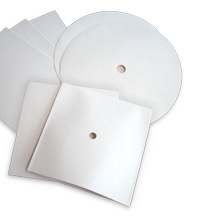
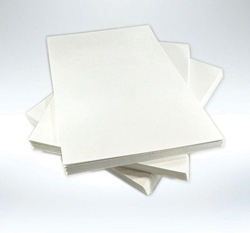
The real breakthrough came in 1990, when Gycor fused the active powder directly into the filter paper.
“It was a simple, one-step process,” adds Rogers. “It was also far easier for restaurant management to monitor.”
The integrated Filter Power Pad became Gycor’s flagship product and is now used across major chains, including Burger King, Kentucky Fried Chicken, Chili’s Grill & Bar, Arby’s and Hardee’s, to name a few. Instead of creating value by adding more steps or features, it removed one.
Decades later, that same principle guides Gycor.
“We offer a range of solutions for different kitchen setups, but the goal is always the same,” says Rogers. “We’re constantly refining our lineup to make filtration more adaptable, more reliable and easier to execute. Whatever changes around the fryer, the standard of filtration should remain consistent.”
Preserving the Oil, Not the Impurities
Removing crumbs is only one part of frying oil filtration. Gycor’s FRI-MORTM powder and integrated filter pads go further, adsorbing impurities that degrade oil quality while returning more usable oil to the fryer.
We offer a range of solutions for different kitchen setups, but the goal is always the same. We’re constantly refining our lineup to make filtration more adaptable, more reliable and easier to execute. Whatever changes around the fryer, the standard of filtration should remain consistent.
“Think of your fist as being a particle of filter powder,” says Rogers. “The oil comes past your fist, all the impurities stick to the outside of your fist. That’s called adsorption and then the oil continues.”
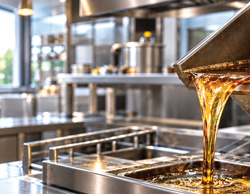 That distinction matters because some filtration media work through absorption, in which oil enters the filtering material itself and doesn’t return to the fryer. Gycor’s adsorption-based approach retains less oil within the media, so more of it stays usable.
The stakes behind that chemistry are practical. Left unfiltered, frying oil breaks down within a few days and starts absorbing into the food itself, the difference between a crisp order of fries and one left soggy with grease. Filtering daily keeps oil and food quality consistent. Skipping proper filtration media altogether to cut costs directly compromises food quality and rapidly degrades oil life.
“It’s almost the same as buying a cheap version of something instead of getting a quality version,” says Rogers. “It tends to break or have problems you have to work with, instead of using the product that’s the better product.”
For restaurant operators, that difference shows up in add-back, the fresh oil needed to bring a fryer back to its proper fill level after filtering. Media that absorbs oil requires more add-back. Media that adsorbs impurities requires less.
 “There’s a big difference in price between the pads and the paper,” says Rogers. “But then they don’t realize that oil costs a heck of a lot more than filters.”
One customer tested Gycor’s filter pads against the plain filter paper it had been using. During the test, the restaurant reduced its weekly oil order by one case of fryer oil. Based on the customer’s oil costs, Gycor calculated savings of $5,460 over the test period.
The result reframed the purchasing decision. The restaurant was no longer comparing the price of one filter against another. It was weighing the cost of filtration against the value of oil that stayed usable longer. For Gycor, oil quality and operating cost aren’t separate arguments. They’re the same one.
Earning Standardization One Test at a Time
Major restaurant chains do not standardize filtration media after a single demonstration. Gycor’s adoption process is built around proving performance through progressively broader testing. An initial evaluation leads to field testing, and if necessary, an expanded trial across more restaurants before final approval.
 Once approval is secured, Gycor turns to distribution. It works through mainline distributors such as US Foods, Performance Food Group and McLane, which deliver filtration products alongside a restaurant’s other supplies and through smallwares distributors, including Edward Don, Franke, FMP and DMI, for products that don’t move enough volume to justify shelf space on mainline shelves. The model lets each chain choose a supply route that fits its existing purchasing structure.
Once testing, approval and distribution are settled, Gycor’s focus shifts from winning the account to keeping it supplied.
Support That Stays Out of the Way
Successful implementation often shows up as what no longer needs attention. Most customers use the product without issue once it’s established in a kitchen. Support becomes necessary when something changes: a new fryer, a new location or a filter size that no longer matches the equipment in place. Gycor works with the operator to identify what’s needed and recommend a suitable option so filtration continues without interruption.
-
They’re more of a partner than a customer at times.
Communication stays open partly through the product itself and partly through industry events. Gycor regularly attends regional shows tied to major restaurant concepts, running six to ten a year with partners like Burger King and KFC alone, giving its team a chance to talk with franchise owners about changes taking place across their operations, sometimes well before those changes require a support call.
“They’re more of a partner than a customer at times,” says Rogers.
Reliability Has a Long Memory
Gycor’s continuity with customers is matched by continuity inside the business. Rogers joined Gycor in 1989 and has spent most of its history helping guide its growth. Many colleagues have built similarly long careers there, while the least tenured employee has been with the business for about 12 years.
That tenure means less time spent retraining and more time spent applying what the team already knows and the customers who depend on it.
Gycor manufactures its filter powder in-house, then ships it to a papermaking partner, which builds the powder into filtration media and returns it to Gycor for converting and final packaging. Sales follow a similarly lean structure. Rogers works alongside direct sales representatives, while distributor partners and outside channels extend Gycor’s reach into restaurant networks.
This compact structure has the closeness of a family business, not that of a large corporate conglomerate.
Removing the Distance to Independent Kitchens
Gycor’s next growth opportunity may not require new filtration technology. It may only require making its existing products easier for smaller restaurants to find. Its distribution model has historically worked best with large restaurant chains and established distributor networks. Independent restaurants and smaller concepts tend to buy through different channels and have had less exposure to specialized filtration media as a result.
 Gycor is testing new ways to close that gap, from selling directly through Amazon to attending restaurant and maintenance shows outside its usual event circuit, aimed at operators it hasn’t reached before.
It continues to strengthen relationships with its major customers without trading one for the other. A redesigned website supports both efforts, giving smaller operators an easier way to research Gycor’s products before they ever talk to a distributor.
Gycor’s product line has changed only three times in 40 years, from bulk powder to a portioned kit to the integrated pad. Each change removed a step, not added one. That pattern, more than any single ingredient or formula, is what the Food and Beverage Tech Review’s Top Cooking Oil Filtration Systems 2026 nomination recognizes.
When less stands between an operator and effective filtration, more oil stays in the fryer.
Control Cooking Oil through Daily Filtration
Cooking oil filtration is purchased as a consumable, but its economics are decided by behavior at the fryer. A restaurant can buy high-quality media and still lose money when staff skip daily filtration or use inconsistent amounts of filter powder. The resulting exposure exceeds the price of the media itself. Oil turns over faster, while fried food can carry more grease and lose consistency.
Daily execution becomes a serious buying issue. Filtration routines have to survive shift changes and uneven training without adding another complicated task to the kitchen. Products that rely on accurate powder measurement leave room for underuse or overuse, while skipped dosing creates an additional failure point. A format that fixes the filtration dose within the media reduces that variability and gives management teams a clearer way to monitor whether the process is actually being followed.
Filtration performance also deserves closer scrutiny than particle removal alone. Crumbs and suspended fines matter, but buyers should examine how the media handles chemical impurities and how much usable oil is retained during the process. Some filtration materials trap contaminants by absorbing oil along with them, increasing the amount that must be added back to restore the fryer level. Media that adsorbs impurities while limiting oil retention changes that equation. Across a large restaurant estate, small differences in add-back can compound into a significant purchasing expense.
“Gycor International’s filtration approach uses adsorption to capture impurities while limiting the amount of oil carried away with the media, which can reduce add-back compared with more absorptive methods.”
Equipment fit is another practical test. Restaurant groups often operate mixed fryer fleets, particularly after remodels or acquisitions. A filtration program becomes harder to standardize if media is available for only a narrow range of machines. Buyers should look for compatible sizes across common fryer configurations and for a supplier model that can keep product moving through existing restaurant purchasing channels. Availability matters most when a product is meant to be used every day. Broad compatibility also reduces the likelihood that a new fryer or replacement filter machine forces a location into a separate consumables routine.
Unit-price comparisons need the same discipline. Plain filter paper may appear economical, while a powder-assisted medium carries a higher purchase price. The better comparison is total oil consumption over the replacement cycle. A lower-cost filter that extends oil life less effectively can create a false saving. Management teams should judge filtration media against oil usage and add-back requirements, then weigh whether the format improves daily execution enough to protect those economics across locations.
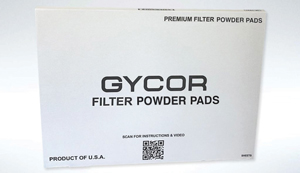
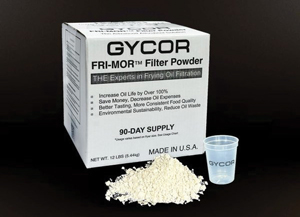
Gycor International merits consideration as a premier choice under this buying logic. Its cooking oil filtration line spans plain filter paper and powder-based media. Fri-MOR Filter Powder is available in bulk, while its filter powder pad incorporates the powder directly into the paper medium. The pad creates a one-step daily format that reduces dosing inconsistency in restaurant filtration routines. Its filtration approach uses adsorption to capture impurities while limiting the amount of oil carried away with the media, thereby reducing add-back compared with more absorptive methods. Gycor also offers pad sizes for a broad range of fryer and filter-machine configurations. For restaurant groups prioritizing consistent use and oil control, it merits serious consideration.
...Read more
| |
Company
Gycor International
Management
David Rogers, President
Description
Gycor International provides cooking oil filtration products for restaurant chains and independent operators. Its Filter Powder Pad combines filtration paper with embedded treatment powder, helping kitchens extend oil life, protect food quality, reduce waste and make filtration easier to monitor consistently.
"We offer a range of solutions for different kitchen setups, but the goal is always the same. We’re constantly refining our lineup to make filtration more adaptable, more reliable and easier to execute. Whatever changes around the fryer, the standard of filtration should remain consistent."
- David Rogers, President
Top
