THANK YOU FOR SUBSCRIBING

 Nik Ocello, Sales Director
In food processing, that can mean a surprising amount of usable product is left behind after a production run. Consider a yogurt plant with a 30,000-gallon tank feeding a filling machine. Once the tank has been emptied, yogurt still occupies the pipeline. Before modern clean-in-place practices became standard, manufacturers often flushed such lines with water or dismantled them for cleaning. Neither approach did much to recover the product itself.
Laufer Valve Technology addresses that gap with its LIAG® DMV pigging system. A pig is sent through the line to push the remaining product out before cleaning starts. The system can remove about 99 percent of the product left in the pipeline, depending on the application.
“I would say that the biggest savings are probably in the reduction in lost product,” Nik Ocello, Sales Director, Laufer Valve Technology.
The economics are fairly simple. Product sitting in a pipe has already been mixed, processed and paid for. If it can be recovered and packaged, it becomes saleable rather than waste. Reduced cleaning time, chemical use and freshwater consumption can be additional benefits, but Ocello identifies lost product as the biggest source of savings.
Built for the Reality of Plant Piping
The pig itself is central to how the system works. Laufer uses a soft material comparable to surgical-grade silicone rather than a rigid construction. That allows it to travel through standard-radius 90-degree and 45-degree bends. For an older plant, this can be significant. Existing pipework does not necessarily need to be redesigned with long, sweeping turns solely to accommodate the pigging system.
Its sealing mechanism also adapts to conditions inside the pipe. The pig’s lips can flare outward or compress against the internal diameter as it moves, maintaining contact through straight runs and bends. Ocello notes that this dynamic seal requires less pushing pressure than harder, oversized pigs.
-
I would say that the biggest savings is probably in the reduction in lost product.
That becomes useful with products that are difficult to move once a line sits idle. Chocolate, soft cheese, dressings and other viscous materials can cool or harden between batches. Promptly removing the bulk of the material leaves the CIP system with considerably less to clean.
LIAG’s pigs are also kept outside the process line until a pigging operation takes place. They are not continuously exposed to flowing product, an approach intended to reduce wear and limit product accumulation around the pig. The company is one of four 3-A certificate holders for CIP pigging systems. Its systems are also distributed by competitors, including another 3-A-certified pigging provider.
Designed around the Plant, Not the Other Way Around
No two processing plants look exactly alike, so Laufer / LIAG® does not treat pigging as an off-the-shelf installation. Engineers begin with the layout and available infrastructure, reviewing P&ID and PFD drawings, line lengths, plant air, propulsion options and CIP capability. Automation is another consideration. Some customers want a fully automated closed-loop system, while others prefer manually loaded pigs with automated steps in between.
The engineering process can also reveal opportunities to simplify a system. Where several process lines are close together, a single launcher or catcher may sometimes serve more than one line.
One recent installation involved a wet pet-food manufacturer with lines running 200 to 300 feet through three- and four-inch piping. The amount of residual product was substantial. The facility later replaced its previously specified pigging supplier and has used LIAG® exclusively for approximately three to four years. It also recently commissioned three additional lines.
Laufer / LIAG® stays involved after the design work is complete. The company coordinates with mechanical contractors and control engineers, provides PLC signal information and participates in startup and testing. Support continues after commissioning when changes to a line or its operation affect system performance.
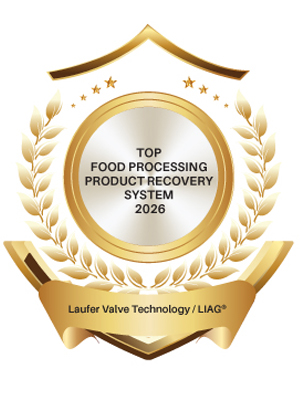
A pigging system is a relatively straightforward idea, but making it work reliably inside an existing food plant requires attention to the details of that plant. Laufer Valve has built its approach around those details, from pipe geometry and product characteristics to automation and long-term operation. Recovering product that would otherwise remain stranded in process lines helps manufacturers capture more of what they have already produced. That practical focus makes Laufer Valve Technology / LIAG® a fitting recipient of the Top Food Processing Product Recovery System 2026 award.
| |
Company
Laufer Valve Technology / LIAG®
Management
Nik Ocello, Sales Director
Description
Laufer Valve Technology Inc. provides hygienic arc valves and product recovery systems for food processing, cosmetics and chemical industries in North America. Its LIAG® technology includes customized pigging systems designed to recover product from process lines while supporting cleaning efficiency and production continuity.
Top
