THANK YOU FOR SUBSCRIBING


 Cordy Rost, Founder and President
ZoRoCo Packaging supports brands through this transition with a partnership-driven manufacturing model.
The family-owned food contract manufacturer and co-packer works with emerging brands as well as multinational companies across frozen, gluten-free and free-from categories. As clients’ products and volumes grow, the team works with them to manage changing production requirements and build the capabilities needed to support their growth. ZoRoCo sees clients’ success as its own, making their growth an important part of its own success.
“If we can partner with our clients and help them put successful, competitive products in the market, they’ll grow, and that will allow us to grow,” says Cordy Rost, founder and president.
The shared-growth model is reflected in ZoRoCo’s longstanding relationship with Prosperity Foods. When Prosperity brought its MELT vegan butter brand to ZoRoCo in 2012, few co-manufacturers offered the capability needed to produce the product. The two companies chose to develop it together, co-investing in a production line. Prosperity focused on marketing, while ZoRoCo handled production, creating a capability that has supported the relationship as Prosperity and its brands have grown.
Building the Right Production Fit
Every partnership begins with a discovery process to confirm ZoRoCo’s capabilities match the client’s needs. Once an agreement is signed, it works with the client to onboard suppliers and ingredients.
It treats communication and shared process discipline as part of manufacturing itself. Both teams develop and confirm product specifications and process requirements, then hold kickoff meetings and prepare for production. A dedicated customer service representative supports the transition and initial production runs, which clients typically attend at ZoRoCo’s facility.
Weekly client discussions, leadership-level alignment and real-time production visibility are designed to keep both sides accountable as requirements change. Discussions address execution, quality control, ingredient needs and customer opportunities. Through ZoRoCo’s ERP and MRP portal, clients can monitor inventory, production requirements, waste, finished goods, outbound shipments and picking activity in real time.
-
If we can partner with our clients and help them put successful, competitive products in the market, they’ll grow, and that will allow us to grow.
Weekly client discussions, leadership-level alignment and real-time production visibility are designed to keep both sides accountable as requirements change. Discussions address execution, quality control, ingredient needs and customer opportunities. Through ZoRoCo’s ERP and MRP portal, clients can monitor inventory, production requirements, waste, finished goods, outbound shipments and picking activity in real time.
Its three specialized plants give it the breadth to respond to different product claims, formats and production requirements.
One facility is entirely gluten-free, excluding gluten from its equipment and raw materials. A second is dedicated to Top 9 allergen-free baking, including cookies and granola. The third handles better-for-you and frozen products such as par-fried vegetables, vegan butter, non-USDA protein meal bowls and dehydrated snacks. Products can be packed in pouches, cups, cartons, trays, tubs, sticks and bowls.
Maintaining such a diverse set of capabilities requires employees who understand different equipment and production processes. ZoRoCo relies on a core group with the knowledge, expertise and shared values to manage those differences, solve problems and partner with clients as their needs change.
Delivering on Production Commitments
Across ZoRoCo’s capabilities, reliability is essential because clients depend on it to execute production commitments and meet the orders they have promised to their own customers. To support its 95 percent MOQ execution guarantee, ZoRoCo relies on close attention to detail, and disciplined processes. It avoids double-booking manufacturing capacity, reserving space against agreed forecasts. Clients support those reservations with purchase-order commitments, creating shared accountability for capacity and execution.
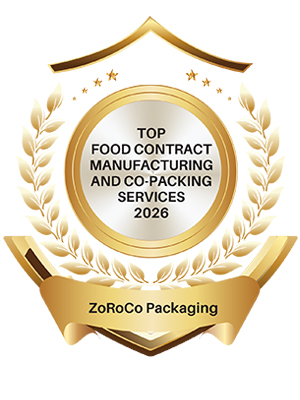
ZoRoCo is expanding its baking capabilities and investing in automation, continuous improvement and internal AI applications. As industry consolidation brings larger, better-funded competitors, it remains focused on larger partnership opportunities while maintaining the culture, communication and accountability of a family-owned business. Its focus on growing alongside clients has earned ZoRoCo Packaging the Top Food Contract Manufacturing and Co-Packing Services 2026 recognition.
When Food Brands Outgrow Their Co-Packer
Food brands rarely outgrow their first manufacturing setup in a clean line. Volume rises unevenly, retailer requirements tighten, ingredient availability shifts, and packaging specifications change faster than production plans. A co-packer that handles an early run well may become a constraint once forecasts change or packaging formats multiply. The more useful comparison is how a manufacturer manages that movement without turning every increase in demand into a new sourcing problem. Procurement teams also need to know whether the provider can absorb changes without destabilizing schedules already committed to other brands.
Capacity discipline deserves close scrutiny because promised volume is only useful when production space is genuinely available. Buyers should understand how a provider reserves line time and how far forecasts must be shared. They should also examine what happens when demand moves outside the original plan and how schedule changes are handled. Overbooking can create missed purchase orders or force last-minute rescheduling. Excess unused capacity can raise costs. The stronger model is one in which both sides understand the volume commitment and the manufacturer can explain how that commitment translates into reserved production time.
Product fit matters just as much as headline throughput. Different food formats can require separate allergen controls, packaging equipment and process knowledge. A supplier that looks flexible on paper may still rely on changeovers that increase contamination exposure or extend downtime. Procurement teams should examine facility-level controls and the range of packaging formats actually run. They should also determine whether the staff operating those lines has experience with the relevant process. Breadth is useful only when the underlying execution remains controlled.
“ZoRoCo Packaging uses capacity reservations rather than routinely overbooking production, giving brands room to scale against agreed forecasts.”
The handoff from onboarding to routine production is another point where problems surface. Ingredient specifications, finished-product standards, supplier approvals and packaging requirements must be settled before the first run rather than repaired afterward. Regular project communication is equally important once production starts. Food brands need a clear route for resolving quality issues and adjusting forecasts. Shipment coordination and production changes should be handled through the same defined communication process. Visibility into inventory and production status can reduce the lag between a problem appearing and a decision being made.
Scaling economics should also be tested before volumes rise. Smaller brands often enter co-manufacturing with one cost structure, then need process changes or equipment investment to support larger runs. Buyers should ask how the manufacturer approaches those changes and whether capacity can expand without forcing a full supplier transition. A useful partner should be able to show how process adjustments are evaluated and how production risk is balanced against cost. Timing should be explicit rather than treated as a secondary detail after equipment or process decisions are made.
ZoRoCo Packaging operates a three-plant network that includes dedicated gluten-free and free-from facilities alongside broader manufacturing capacity. Its portal access gives clients real-time visibility into inventory, production requirements, finished goods and outbound shipments, reducing avoidable gaps between planning and execution. The company also uses capacity reservations rather than routinely overbooking production, giving brands room to scale against agreed forecasts. Dedicated customer service representatives and recurring meetings support the move from onboarding into production, while specification work is established before initial runs. For buyers that need varied food manufacturing capability plus disciplined capacity management, ZoRoCo merits consideration as a contract manufacturing and co-packing partner.
...Read more
| |
Company
ZoRoCo Packaging
Management
Cordy Rost, Founder and President
Description
ZoRoCo Packaging is a family-owned food contract manufacturer and co-packer serving emerging brands and multinational companies. Its three plants support gluten-free, free-from, frozen and better-for-you products across multiple formats. ZoRoCo partners with clients through product development, production and scaling, building capabilities around changing needs and long-term growth.
Top
